

Copper
A Lake Superior Horror

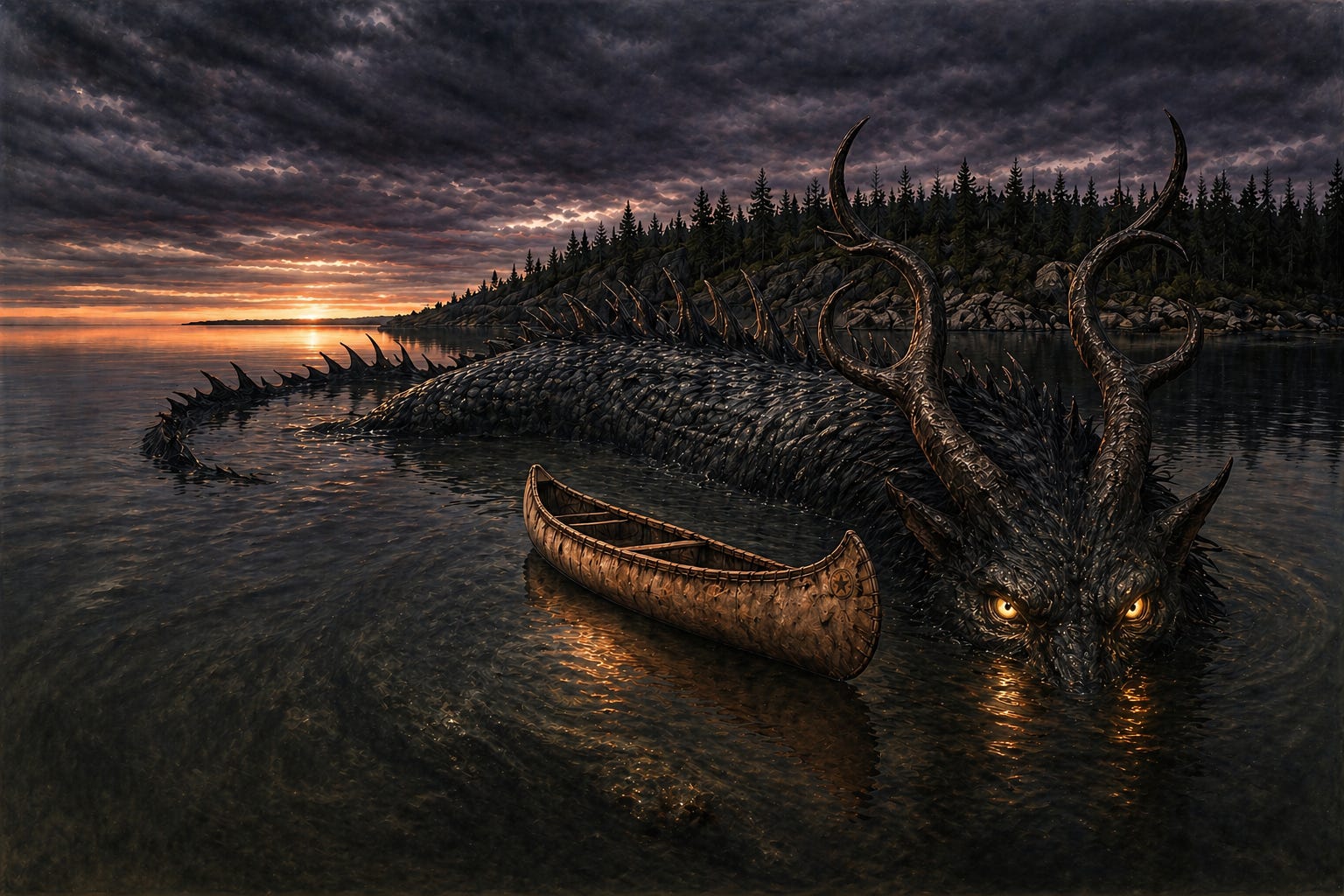
Nookomis had been coughing for three nights, and each time it sounded thinner. When I lifted her in the morning, she weighed nothing at all. The cabin held that sweet smell I remembered from my mother, before she died.
So I paddled out to Michipicoten Island.
I knew the stories. My grandfather had told them to me by the fire, in the voice one uses for truths, not for tales. I murmured no prayer as I slipped the lump into my pouch. I did not want him to hear who I was.
The copper burned in my pouch as I pushed the canoe from the shore. Days lay ahead of me on the water, hugging the coast all the way to Bawating1, where the trader paid well and asked no questions about where things came from. A long and brutal journey. But for Nookomis it was worth it.
Lake Superior lay still as lead. Too still. No wind, no birds. My paddle sounded too loud in the water, as though it were dragging across something solid.
The island was barely an hour behind me when I smelled copper in the air, where no copper could be. A shadow slid beneath the canoe, too large for a fish, too slow for a current. It followed me without overtaking. The copper in my pouch grew heavier. Warmer. As if it were pulling downward.
Then the water began to boil. Not hot. Cold.

A swelling rose beside the boat, black and endless. At first, I thought a log had surfaced. Then I saw the scales, raised like blades, running in a row along a back that did not end. Horns broke the water, shaped like the antlers of a stag, but something about them was wrong, they tapered too sharply and curved where they should have run straight. Wet feathers clung to the neck, black and heavy, and where they ended, they gave way to fur, which in turn became scales, as though the creature had been assembled from several animals by a hand that did not know where one should stop and the next begin. Last came the eyes, yellow and feline, large as my fists, and they did not look at me the way an animal looks, but the way something looks that has been waiting a long while.
It hissed. The sound was rapids and storm at once, ran through my bones and loosened something inside them.
I threw the copper into the water. It hesitated. For one breath it hung there, as though the choosing were not mine but its own. Then it sank.
Too late.
A paw, broader than my canoe, struck up from the depths at me. Claws like a wildcats, but six on each hand, too long, curved like fish hooks. The tail came last, lashed around the hull, endlessly long, serpentine, and dragged me under.
Water filled my mouth. I looked upward, through the blackness, and the last thing I saw was a lock of my own hair, drifting toward the surface. Toward the sun. Without me.
1Bawating, “Place of the Rapids,” is the name by which the Ojibwa have known, for centuries, that stretch of Lake Superior where the St. Marys River breaks into thundering rapids. French Jesuits founded a mission there in the seventeenth century and called the place Sault Ste. Marie. In the old stories, the roaring and hissing of the Mishipeshu can still be heard in those very rapids.

Author’s note
I’m Sacha, a writer based in Switzerland, currently working on my first full-length novel. Fragments and the Dark is my home for the shorter pieces: stories, fragments, experiments, and a chance to connect with readers who share a taste for the darker corners of fiction.

I’d love for writing to one day become my full-time work. If you’d like to help me along that path, you can buy me a coffee or become a paid subscriber using the buttons below. And if that’s not for you right now, a like, comment, or restack genuinely makes a difference too.

Thank you for reading. 🖤

The spine of this story is the human opening and the line 'I did not want him to hear who I was.' That sentence does theology, character, and doom in nine words: he believes enough to hide his name, and steals anyway. The whole tragedy is already in it.
Three suggestions. The creature is over-itemized; horns, feathers, fur, scales, catalogued one by one, and then the genuinely brilliant sentence, 'assembled by a hand that did not know where one should stop,' arrives too late to ignite them. Cut a third of the anatomy and let that sentence do the work. 'Boiling cold' made me stumble rather than shiver; 'the water boiled, and no heat came off it' keeps the wrongness without the contradiction. And Nookomis opens the story, then vanishes from it. Give her one heartbeat inside the drowning, the medicine that will never arrive, and the ending stops merely landing and starts to hurt.
The lock of hair rising toward the sun without him is a superb final image. It deserves that one extra wound beneath it
A very elegant, mysterious story. Beautiful!